





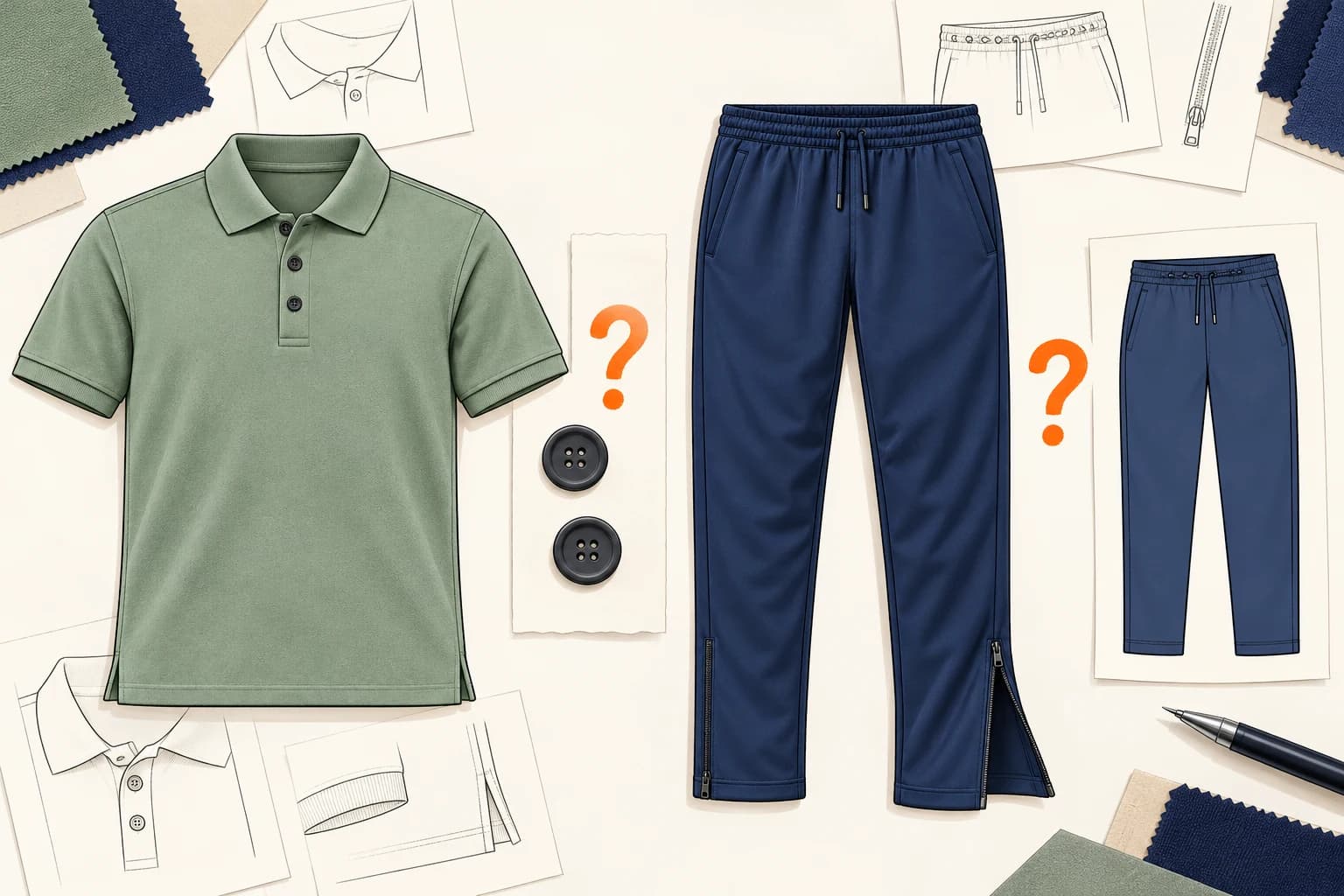
Your polo drawing shows three buttons, but the trim instruction lists two. Your training-pant detail shows an ankle zipper, but another drawing closes the side seam to the hem. The supplier can make a guess, yet that guess becomes an avoidable first-sample decision made without you.
Use a garment spec sheet review to return those precise questions before pattern and sample work starts. This guide concerns conflicting inputs, not approval of a physical sample. The sage polo and navy pants below are proposed development references, not customer orders or accepted production specifications.
01 · Decision record
Define what your garment spec sheet controls
Teams use the term differently. Delogue describes a spec sheet mainly through measurable garment requirements, while distinguishing the wider tech pack. Fabrikn’s manufacturing guide discusses a broader set of garment instructions. Agree your document’s purpose instead of assuming the same label means the same contents everywhere.
Here, the review covers the identified measurement/specification sheet and its linked drawings and component instructions. Together they tell the sample team what to build. It is not a universal template, a substitute for a complete technical pack or a promise that every factory uses one document format.
Name the style and identify the files being reviewed. State which instructions govern appearance, finished measurements and components. If those instructions disagree, do not use a file’s attractive layout or later email timestamp as an automatic technical answer. Ask the owner of the requirement to resolve the specific discrepancy.
02 · Decision record
Case one: three buttons drawn, two specified
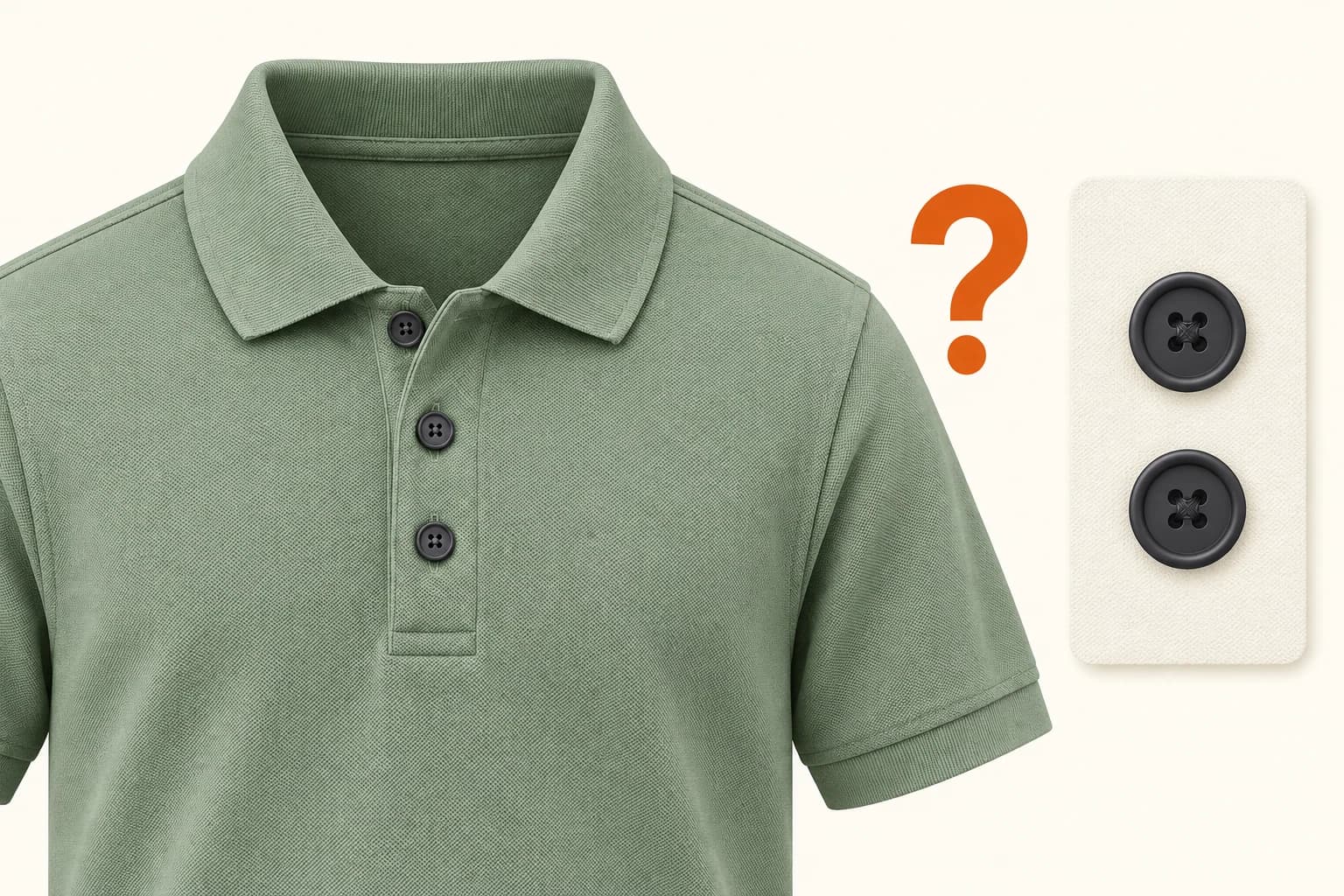
The proposed three-button team polo has a turn-down collar and a partial front placket. Its drawing contains three button positions. Suppose the attached trim instruction instead calls for two matching buttons per garment. Both instructions cannot describe that same build without clarification.
Do not tell the sample room simply to use the drawing. The trim row might be stale, or the design might have changed intentionally. Ask the buyer’s product owner which button count and placket construction are intended. Include the exact drawing reference and trim row in that question.
The answer affects more than the number of loose buttons. The team needs an agreed relationship between the placket length, button positions, buttonholes and placket base. A sample made with two positions cannot demonstrate whether the proposed three-position layout matches the buyer’s intent.
Return a question that can be answered
Write: “The front drawing has three button positions; the trim instruction supplies two. Which construction should the first sample follow?” Ask the buyer to provide the corresponding revised instruction, not only a reply saying “three is correct.” The component and construction references must describe that answer together.
Do not invent a placket dimension or button spacing to close the issue. If those details are not supplied, identify them as proposed development choices requiring review. The supplier can explain feasible directions, but the buyer must know which decisions remain open before work begins.
The result is an input clarification, not a sample approval. Once the documents describe one intended construction, the team can consider the first-sample task. Physical appearance, closure operation, collar compatibility and fit still need later sample review.
03 · Decision record
Case two: an opening detail versus a closed hem instruction
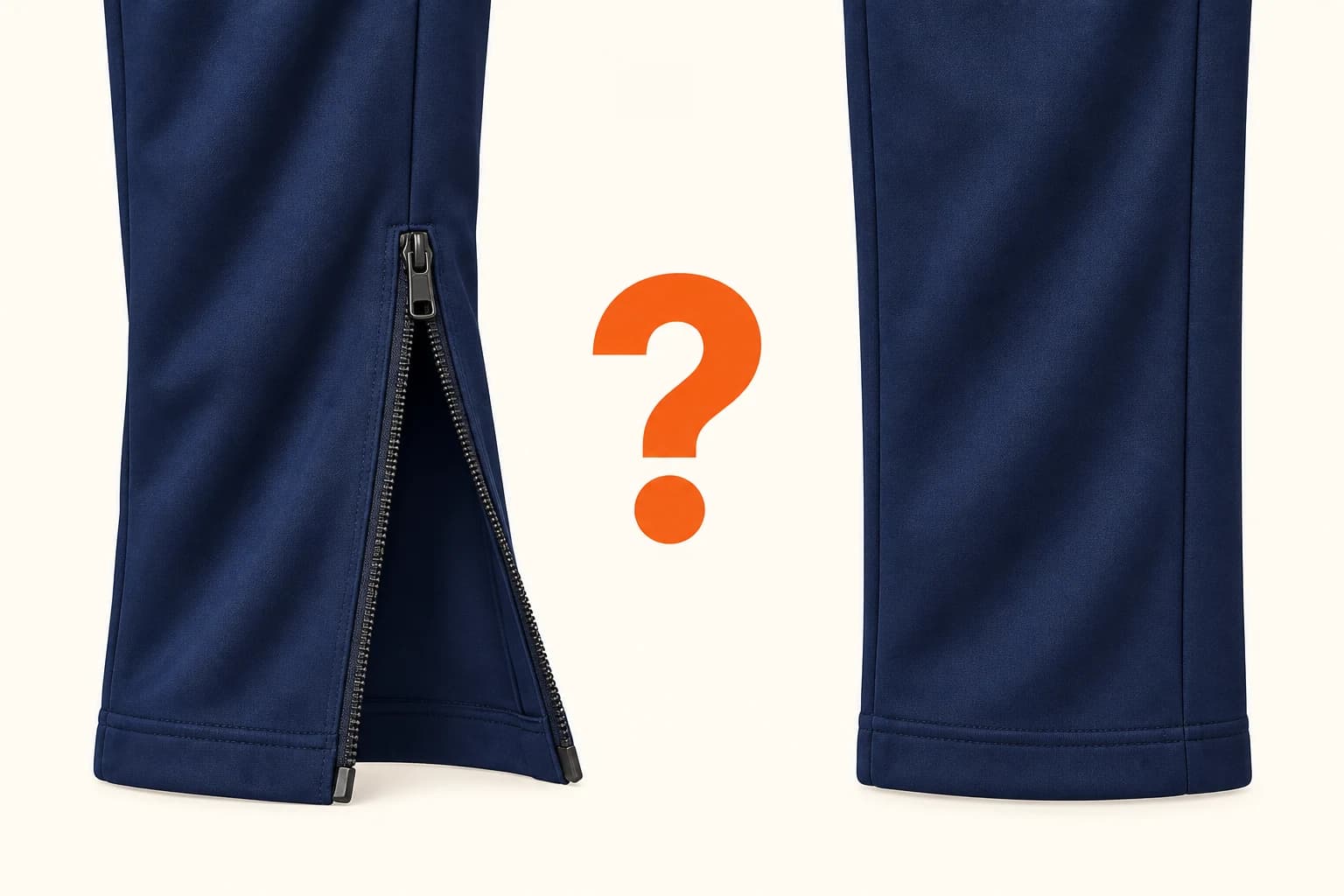
Now consider the proposed ankle-zip team track pants. The detail view shows an outer ankle opening extending upward from an open straight hem. A separate lower-leg instruction shows an uninterrupted side seam ending at an unbroken hem, with no zipper opening.
Ask whether the sample requires that ankle opening or the closed construction. Do not assume the missing zipper is an artistic simplification. It may represent a different instruction for the seam and hem. The sample team needs the intended assembly, not a guess about the illustrator’s intention.
This is a different kind of conflict from the polo count. The polo has incompatible component quantities. The pants have incompatible assembly instructions. Buying teams should name the difference, because the person who can confirm an artwork detail may not own the pattern or component decision.
Link the answer to the actual lower-leg build
If the buyer confirms the zipper opening, ask for a consistent detail showing its position, opening extent and hem relationship. Identify the zipper/component reference and any unfinished choices. Leave missing dimensions explicit; do not copy a length from an unrelated style.
If the buyer wants a closed seam instead, identify which drawing and component instruction must change. Otherwise the sample room could correctly follow the closed drawing while purchasing prepares zipper components for an opening that no longer exists.
Also separate visible geometry from intended function. An open zipper illustration does not prove shoe-on changing, a sport-rule requirement or comfortable slider contact. If those outcomes matter, record them as distinct development questions for appropriate sample and evidence review. They are not resolved by making the inputs consistent.
04 · Decision record
Check the relationship, not just whether a field is filled
A document can have every box completed and still contain incompatible instructions. Compare linked requirements that control the same feature. For the polo, relate the front view, placket detail, button row and buttonhole instruction. For the pants, relate the side seam, opening detail, zipper reference and hem instruction.
Mark each relationship as consistent, contradictory or incomplete. “Incomplete” matters when the available files cannot establish whether a conflict exists. If a detail is too small to read, request a usable view; do not treat silence as confirmation of the most convenient construction.
Use actual requirement references in your note. A question such as “please check the pants” creates another broad review. A question linking the lower-leg detail to the closed-seam instruction tells the responsible person exactly what must be reconciled.
05 · Decision record
Recognize measurement ambiguity without rewriting the size system
A finished dimension can also conflict with its illustration or measurement description. If an opening value has no clear endpoints, the pattern team cannot know which part it describes. Ask for the intended endpoints, units and measurement condition rather than selecting them yourself.
Keep body measurements distinct from finished-garment dimensions. If both appear without labels, return that specific ambiguity. You do not need to calculate a new grade rule or establish a complete size range merely to identify that the first-sample input is unclear.
The garment size grading guide covers repeatable measurement definitions, grade relationships and size-set review. Use that separate process when those decisions are needed. This input check ends with a clear requirement or a named question; it does not approve the fit of unmade garments.
06 · Decision record
Assign the question to the person who owns the decision
Identify whether the discrepancy concerns design intent, a technical specification or a component choice. The sourcing contact may coordinate the reply, but coordination does not make every technical decision theirs. Name the buyer-side owner and the supplier-side person who needs the answer to proceed.
Describe the blocked task precisely. For the polo, it may be setting the intended placket layout. For the pants, it may be developing the lower-leg seam/opening assembly. Other unrelated preparation can be discussed separately, without representing the whole style as technically ready.
Ask for one complete answer across the affected inputs. A message confirming the zipper while leaving the closed-seam drawing unchanged creates a fresh ambiguity. The resolver should identify the governing construction and the corrected references that now describe it.
07 · Decision record
Keep the discrepancy list short enough to use
A useful entry contains the style/feature, two conflicting sources, the consequence for the first sample and the precise question. Add the responsible resolver and the instruction needed to close that question. Where a value is genuinely undecided, label it open rather than supplying a plausible number.
For the polo entry, record three drawn positions against two instructed buttons and ask for the intended placket/count combination. For the pants entry, record an open zipper detail against a continuous closed seam and ask which assembly should be developed.
Do not fill the list with every future inspection or purchasing task. The purpose is to remove contradictions before the first sample starts. A concise readiness response is more useful than a long checklist that hides the two decisions preventing the sample team from interpreting the brief.
08 · Decision record
Know when this review is finished
The review can conclude when the affected instructions describe one intended build and remaining development choices are understood. Identify which first-sample work can start from those inputs. Record unresolved questions that still prevent a particular task; avoid a vague “approved with comments” status.
This conclusion does not certify a physical result. The garment sampling guide addresses later sample stages and sample-to-bulk approvals. The garment costing guide addresses comparable quotation scopes. Neither process should be compressed into this document-input decision.
09 · Decision record
Questions from apparel buying teams
Can a reference photo resolve the contradiction?
It can help explain appearance, but it may not identify internal attachment or a governing dimension. Ask which requirement the photo establishes and which details still need a drawing or written answer. Do not assume an unseen construction from the outside view.
Should the factory choose the missing value?
The factory may propose a feasible direction for buyer review. Identify it as a proposal and explain what it affects. A supplier suggestion is useful when everyone understands the open decision; it should not become an unnoticed fixed specification.
What should we send to begin the discussion?
Send the style reference, legible drawings, component directions and available finished-garment specifications. Include the two instructions that conflict and your intended use. A direct question about a placket or ankle opening gives the technical team a concrete starting point.
10 · Decision record
Bring one interpretable brief to the first sample
Forthright supports buyer-led apparel development with MOQ of 300 pieces per style and color. Samples usually take 7–10 days after a clear brief; additional development may take longer. Bulk planning is usually 30–45 days after sample approval, order confirmation and material readiness.
Contact Forthright with your proposed construction and unresolved inputs. The next step is to review the brief and feasibility, then agree what the sample should demonstrate. Document readiness starts that work; it does not replace the sample itself.