





01 · Decision record
OEM Apparel Manufacturer RFQ: How to Compare Supplier Quotes
Three suppliers quote the same jacket, yet the totals are far apart. One includes the specified zipper and individual packing. Another assumes a cheaper closure and bulk packing. The third leaves testing and artwork setup unresolved. Choosing the lowest number before checking those differences can commit the buyer to a different product or a different scope of work.
An OEM apparel manufacturer RFQ should make those assumptions visible before the quotation becomes an order. This guide gives sourcing teams a repeatable way to issue one brief, normalize responses, and identify which questions must be closed. The outcome is a comparison that procurement, merchandising, and production can all explain.
02 · Decision record
1. Freeze the comparison brief before requesting prices
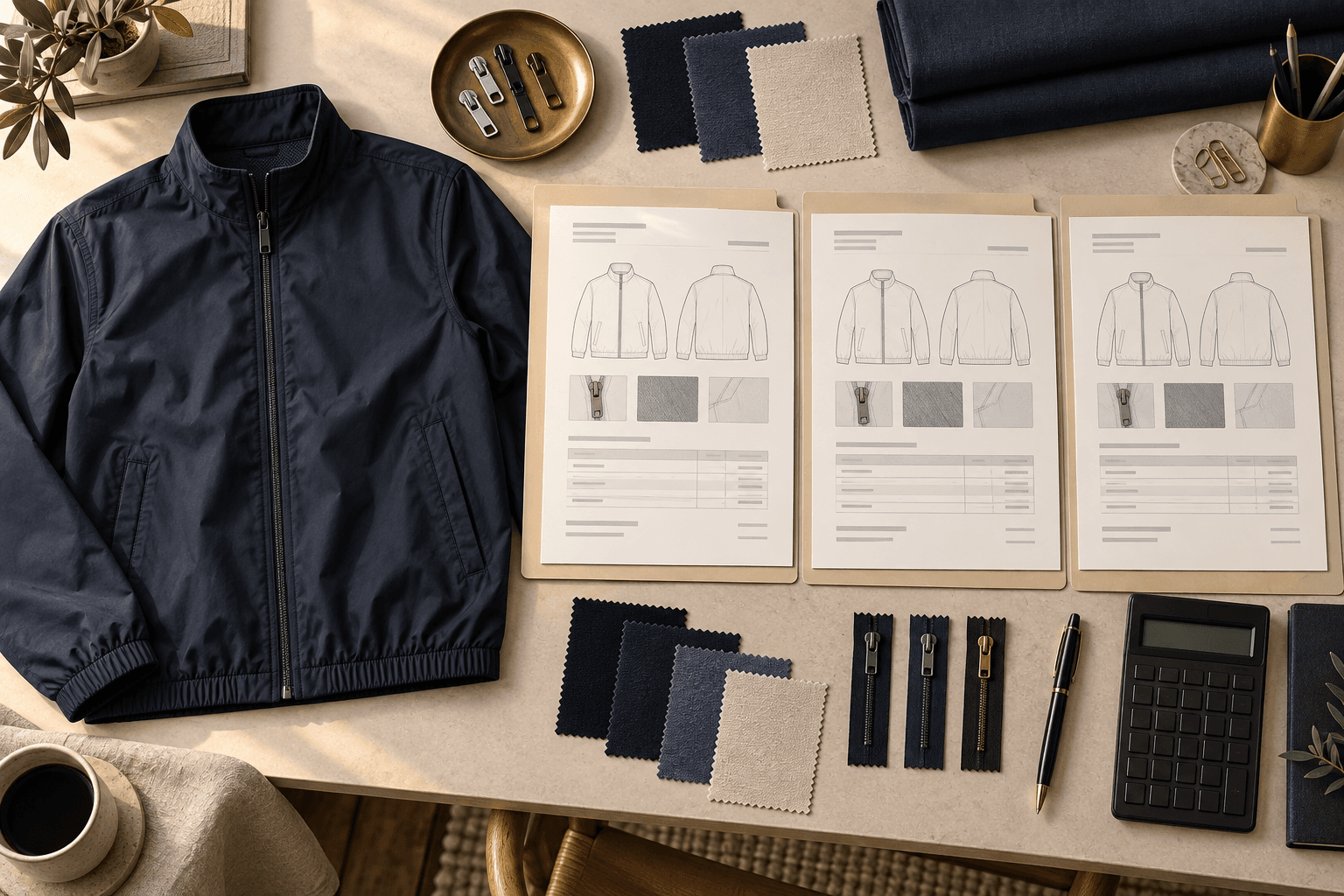
Start with one identified reference package. Include the style code, technical drawing, measurement specification, bill of materials, artwork, and intended packaging. Mark the revision and date on the cover sheet. Tell every supplier which files govern the quotation and which details remain open.
A reference photograph is useful for appearance, but it rarely defines fabric construction, finishing, trim quality, or stitch requirements precisely enough for a comparable offer. Where a specification is missing, ask the supplier to state its assumption rather than quietly selecting an interpretation.
Keep alternatives separate from the base offer. If a manufacturer proposes a different fabric or construction to reduce complexity, request a clearly labeled alternative with the resulting changes. Procurement should be able to compare the requested product first, then evaluate proposed changes on their own merits.
Choose one person to distribute clarifications. A revised sleeve detail sent to only one factory breaks the comparison even if all three quote documents still carry the same style name.
For a windbreaker RFQ, use the lightweight jacket material comparison to separate shell construction, finish and lining decisions. Ask each supplier to quote the same selected specification and identify unresolved tests or packing requirements, so a lower price does not conceal a different garment brief.
03 · Decision record
2. Give the private label garment supplier an actual quantity matrix
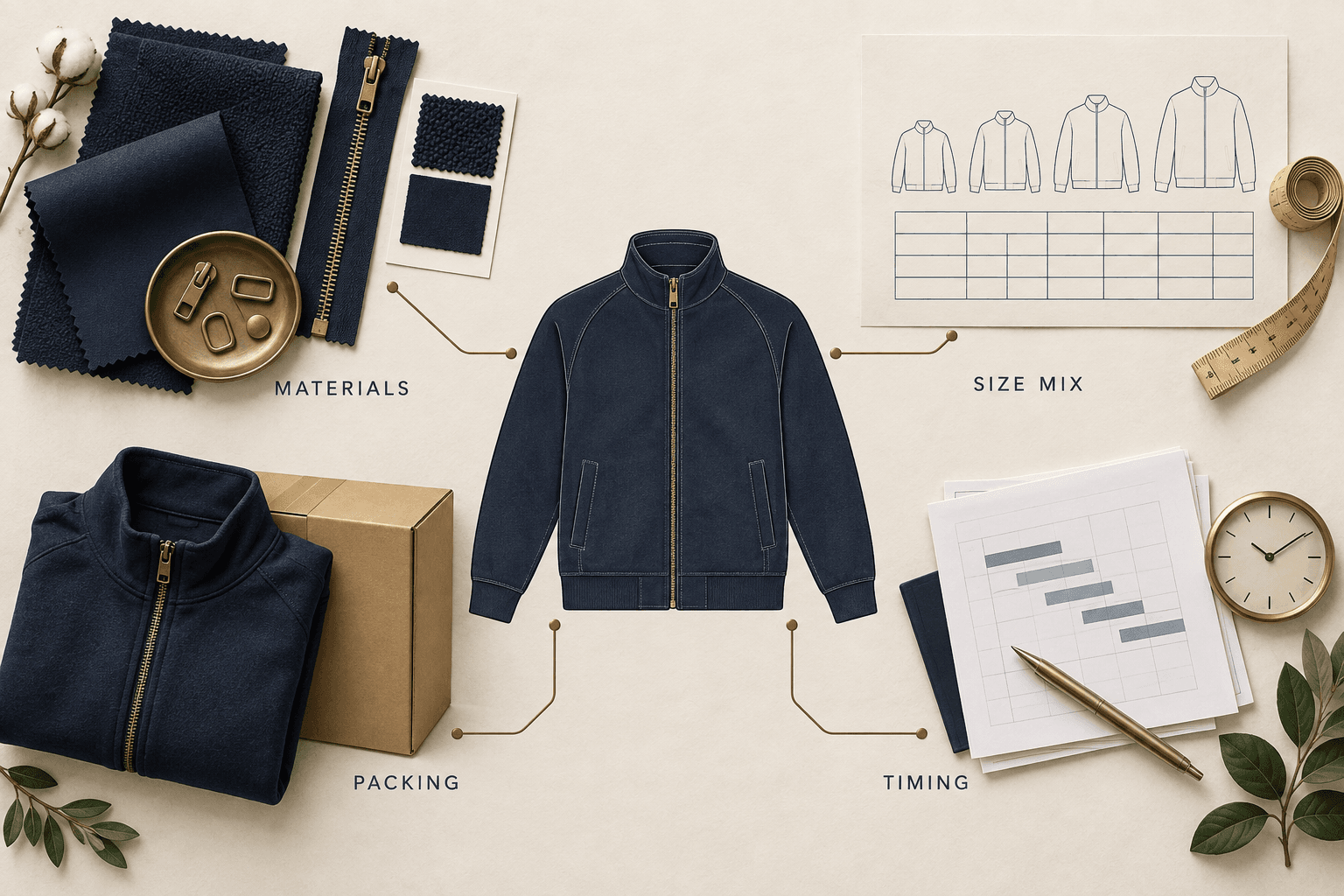
For a private label garment supplier, a headline quantity does not explain how the order is divided. Provide quantities by style, color, and size. Identify whether these are confirmed purchase quantities or scenarios being explored.
An order of several hundred pieces across one color is a different sourcing brief from the same total spread across several styles and colors. Ask suppliers to price the stated matrix and identify any minimums or material commitments that affect it. Do not assume that a total order quantity satisfies every component minimum.
If you need volume comparisons, use the same scenarios for all suppliers. Keep the size distribution and other assumptions visible when changing quantities. Otherwise, a lower unit price may reflect a different order composition rather than the volume effect you wanted to measure.
Record whether excess material, spare trims, or unused packaging creates a separate charge or an ownership question. Resolve that point before treating two offers as equivalent.
04 · Decision record
3. Build an inclusion checklist for the OEM clothing factory
An OEM clothing factory quotation needs a clear boundary around the work included. Create a short checklist and ask the supplier to mark every item as included, separately priced, excluded, or pending confirmation. A blank cell should remain an open question, not become a zero cost in your comparison.
Cover the major production inputs first: fabric, lining where relevant, trims, decoration, labels, and garment assembly. Then cover the less visible work, such as artwork preparation, special packaging, agreed inspection activities, and any requested testing.
Use precise descriptions. “Logo included” does not identify application method, dimensions, colors, placement, or the number of locations. “Packing included” does not specify individual bags, hangtags, size stickers, carton configuration, or buyer labels.
Ask the supplier to identify what would cause the offer to change. A quote based on artwork still under development may reasonably need confirmation later. The important point is to keep that condition visible and assign an owner to close it.
05 · Decision record
4. Separate development charges from repeatable production costs
Do not hide sample development, pattern work, artwork setup, or other one-time charges inside an unexplained unit price. Request separate lines where those charges apply, together with the conditions governing them. A fee may be waived or credited under agreed circumstances, but the quotation should state those circumstances explicitly.
For comparison, show the first-order total and the expected repeat-order basis separately. Use the same quantity and scope when doing so. This prevents a development-heavy first order from being confused with the cost of repeating an already approved style.
Ask what must remain unchanged for a repeat price to apply. Material availability, artwork, packaging, and order composition can all require renewed confirmation. A previous quotation should not be treated as an indefinite commitment when its stated conditions no longer hold.
For a bulk apparel supplier, clarity about development scope also prevents approval delays. Define which sample stages are requested and which decisions each stage is intended to support, rather than assuming every possible revision is included.
06 · Decision record
5. Align the delivery basis before comparing totals
ICC explains that Incoterms rules allocate specified obligations, costs, and risks between buyer and seller. Its guidance also emphasizes naming the relevant place or port and identifying the rule version. Those details matter when offers appear similar but cover different delivery arrangements.
Ask each supplier to state the delivery basis in full and identify excluded services. Have the logistics team confirm that the proposed arrangement fits the actual shipment. A three-letter abbreviation alone is not enough to explain where the quotation's responsibility ends.
Keep production price and buyer-side logistics estimates distinct. Where a freight or handling amount is provisional, show the assumption and the date of the estimate. Avoid presenting an unresolved estimate as a confirmed supplier charge.
ICC also distinguishes these rules from payment arrangements and product specifications. Record those items separately in the purchasing documents. This article does not choose a trade term for your order; the comparison should reflect the arrangement agreed by the parties.
07 · Decision record
6. Normalize offers without inventing missing numbers
Create one comparison sheet with identical rows for every supplier. Record the quoted unit price, currency, order quantity, separately identified charges, delivery basis, validity period, and unresolved assumptions. Add a column showing the evidence supporting each entry.
Use a consistent internal comparison method, approved by your purchasing team, when currencies or timing differ. Preserve the original quotation alongside any converted figures. The purpose is traceability: another reviewer should be able to reproduce the comparison and see which inputs were estimates.
Do not manufacture a number for an excluded service merely to complete a spreadsheet. Request clarification or obtain a separately identified estimate from the responsible provider. Label unresolved lines clearly so a supplier cannot appear cheaper simply because less information was supplied.
The best OEM garment supplier quote comparison explains both the commercial difference and the specification difference. Price ranking should follow that explanation, not replace it.
08 · Decision record
7. Work through one discrepancy before negotiating the whole order
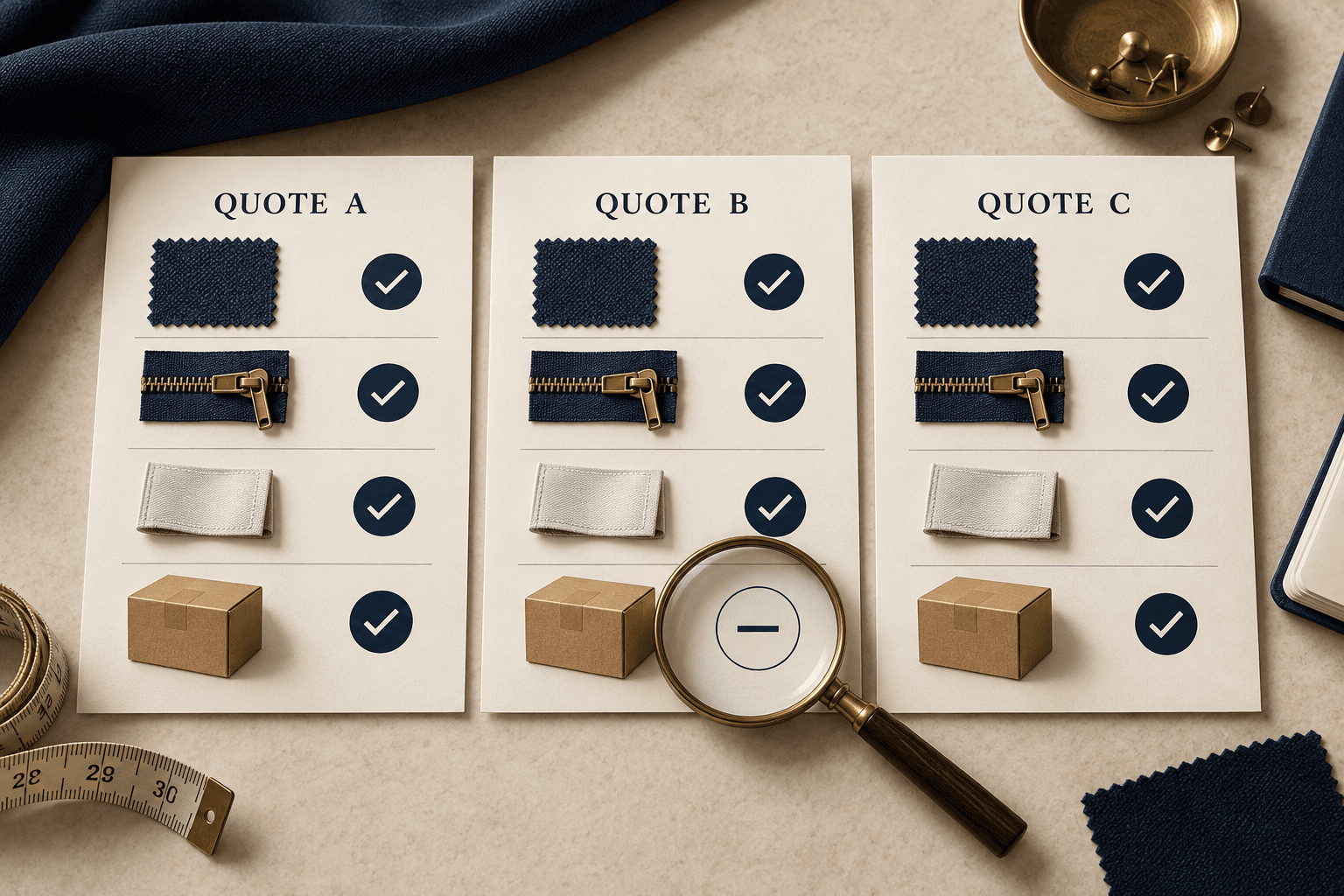
Consider an illustrative quotation exercise for a navy lightweight jacket. Supplier A lists the specified zipper, individual packing, and buyer labels. Supplier B shows a lower garment price but leaves the zipper reference and packing method unspecified. This is a teaching example, not a Forthright quotation or customer result.
The buyer first asks Supplier B to confirm the zipper reference and price the same packing instructions. Supplier B then either confirms the original scope or issues a revised offer. Only after that response does the buyer compare the commercial totals.
If the alternative zipper is acceptable, record it as a separate option and assess the relevant sample evidence. Do not silently change the base specification to make the cheaper quotation fit.
The same method applies to decoration, lining, carton configuration, or inspection scope. Resolve a concrete mismatch, update the comparison, and keep the decision visible. This is more useful than asking every supplier to reduce a number that describes different work.
09 · Decision record
8. Compare approval timing and quotation validity
Ask when the quoted production period starts and which approvals or inputs are required first. Distinguish sample development, material confirmation, production, and shipment preparation. A short stated lead time is difficult to evaluate when its starting conditions are missing.
Request the quotation's validity period and the process for reconfirming an expired offer. If the buyer changes the size mix, artwork, or material specification, ask which parts of the quotation remain valid. Record the revised offer rather than relying on an informal assurance.
For a wholesale apparel manufacturer, the sourcing calendar should also identify who must provide files and decisions. A delay caused by unfinished artwork is different from a confirmed production delay. Keeping those dependencies visible makes supplier comparisons more realistic.
Do not promise an arrival date based only on factory production timing. Transport arrangements and receiving requirements belong in the wider order plan.
10 · Decision record
9. Close the RFQ with a written decision record
Before placing the order, issue a final clarification record linking the accepted quotation to the approved specification revision. List included work, exclusions, pending approvals, commercial conditions, and the agreed next step. Ask the supplier to acknowledge the same document set.
A useful final review checks these points:
- Every supplier response refers to the same style and revision.
- Quantities by size and color match the intended order.
- Materials, branding, packing, and requested checks have explicit scope.
- One-time charges and conditional credits are distinguishable.
- Delivery basis, quotation validity, and approval dependencies are recorded.
- No unresolved blank has been treated as a confirmed inclusion.
Forthright's sitewide starting MOQ is 300 pieces per style and color. Samples take 7–10 days after brief confirmation, and bulk production takes 30–45 days after approval. Send the actual specification and quantity matrix so the sourcing discussion can address your program's requirements.
11 · Decision record
FAQ for B2B apparel procurement teams
What should an OEM apparel manufacturer receive before quoting?
Send the current technical brief, material references, artwork status, quantities by size and color, packing instructions, and intended delivery basis. Identify unresolved details. A supplier can then separate confirmed scope from assumptions instead of hiding uncertainty inside one garment price.
Can a private label garment supplier quote from a reference photo?
A photo can support an initial discussion, but missing technical details should remain explicit assumptions. Before selecting an offer, confirm the materials, construction, measurements, decoration, and packaging that determine what will actually be supplied.
How should an OEM garment supplier explain a higher quotation?
Ask for the scope differences and supporting references. The explanation may involve different materials, included work, quantities, or delivery arrangements. Evaluate those differences against the buyer's requirements before deciding whether the higher quotation provides relevant value.