





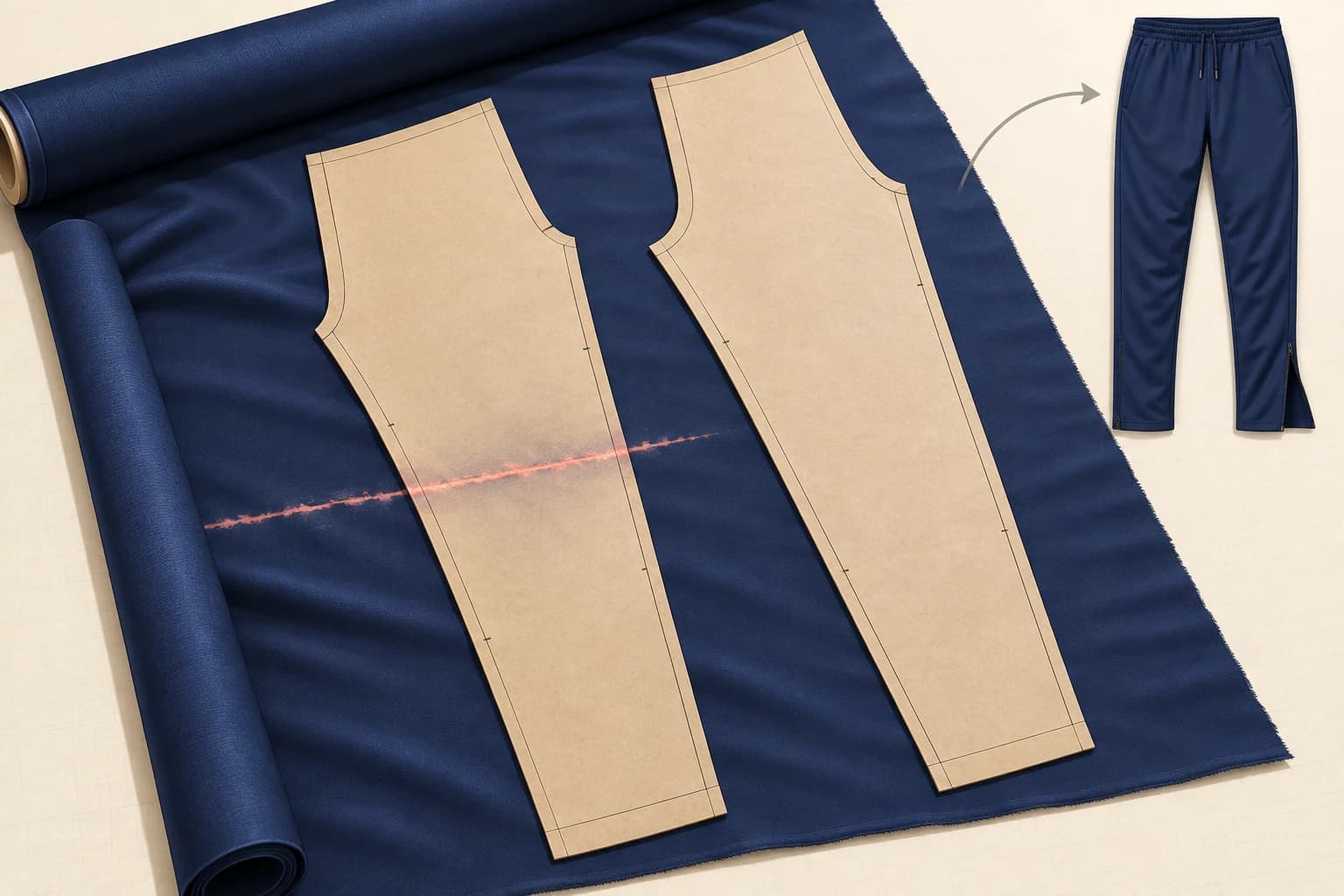
A roll can look acceptable in a summary and still leave your longest trouser panel without a clear cutting position. Before you release cloth, connect visible defects to the garment parts you need. A score describes the agreed inspection result; it does not draw a usable marker for your order.
This guide uses proposed navy team track pants as an illustrative buying case. The long front-leg panel has a curved rise, a knee area and a tapered hem. The question is whether identified incoming rolls support that panel under your agreed material and cutting requirements. No illustrated roll, defect or decision is a real Forthright inspection result.
01 · Decision record
Start with the long panel your order cannot avoid
Your cutting team needs a continuous area for each full-length leg. A short clear patch that could accommodate a pocket bag cannot necessarily accommodate that leg. Ask the technical team which large parts constrain the marker before judging a roll only by its total defects.
Use the current pattern reference and ordered size range. Identify the required direction and any agreed restrictions on turning or placing panels. Do not assume the team may rotate a part, shorten a leg or change a visible seam to work around cloth faults.
For this example, a streak crosses the knee area of one proposed leg position. Moving the panel may help only if another suitable area exists. The buying decision therefore needs the defect location, available width and usable continuous length, not a reassuring summary alone.
02 · Decision record
Agree the 4 point system fabric inspection basis
Before comparing reports, identify the controlled method and the buyer requirements that apply. The public scope of ASTM D5430 covers visual examination and grading of fabrics. It describes roll or shipment acceptance by purchaser and seller agreement and warns that point-assignment choices affect comparisons.
That public scope is not the complete licensed procedure. Ask the inspector and supplier to identify the applicable edition, grading option, examination scope and reporting basis. Where the buyer has a specific manual, identify that document rather than silently combining rules from several internet summaries.
Agree acceptance limits commercially before inspection. A familiar number is not automatically your contract limit. Record whether a limit governs an individual roll, a shipment aggregate or both, and how separately specified rejection issues are handled. Do not compare a length-based value with an area-based value as if they were the same measure.
03 · Decision record
Keep roll identity attached to the spatial evidence
Give every finding a material reference, delivery or lot identity and roll identifier. The width and inspected extent must belong to that same roll. A photograph of another length or an unidentified defect cannot resolve where your long leg can be placed.
Ask how the report locates a finding along and across the cloth. Select an agreed origin and orientation so the cutting team can find it again. Include an overview and a closer image when either alone would conceal the position or character of the issue.
A defect marker at the cloth edge helps locate a finding; it is not permission to ignore it. Establish what that marker means and keep its relationship to the report clear. If the cloth is rewound, divided or relabeled, preserve the connection between the original finding and the resulting roll.
04 · Decision record
Read the map as a garment-cutting question
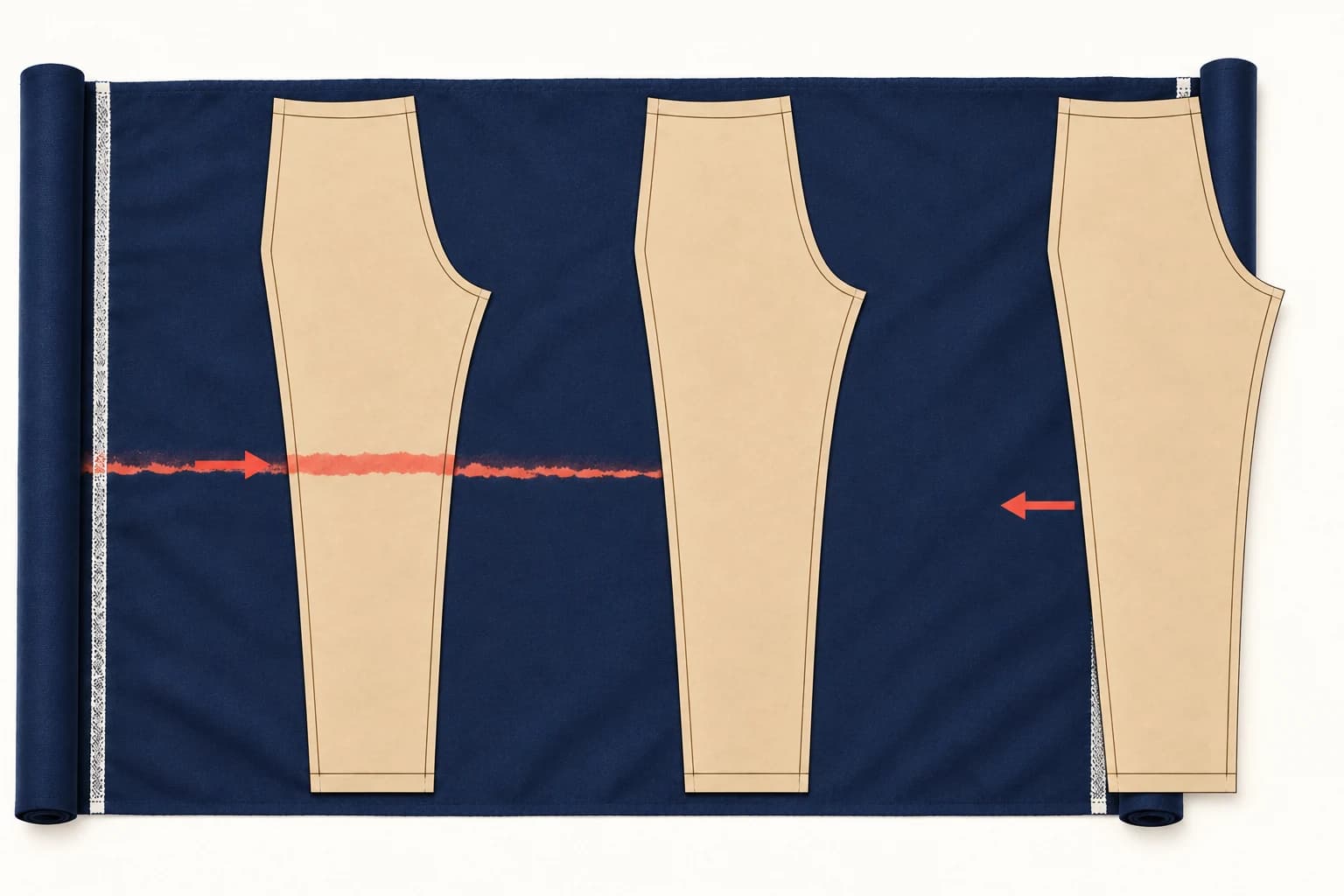
Compare the two leg positions in the illustration. One intersects a marked streak; the other has a clear area. Neither picture establishes how many complete garments the roll will yield. Your cutting team must assess the actual marker, sizes, direction constraints and available cloth.
Ask a specific question: can the affected leg be relocated without changing the approved construction or violating material restrictions? If yes, request the proposed placement and any consequence for consumption or output. If not, identify which quantity or scheduled cutting work remains unsupported.
Keep usable width separate from nominal width. A panel that crosses the usable boundary does not become acceptable because the roll label lists a larger width. Confirm where that boundary is measured and whether edge conditions or other exclusions affect it. Do not invent an allowance to make a panel fit.
05 · Decision record
The same score can create different decisions
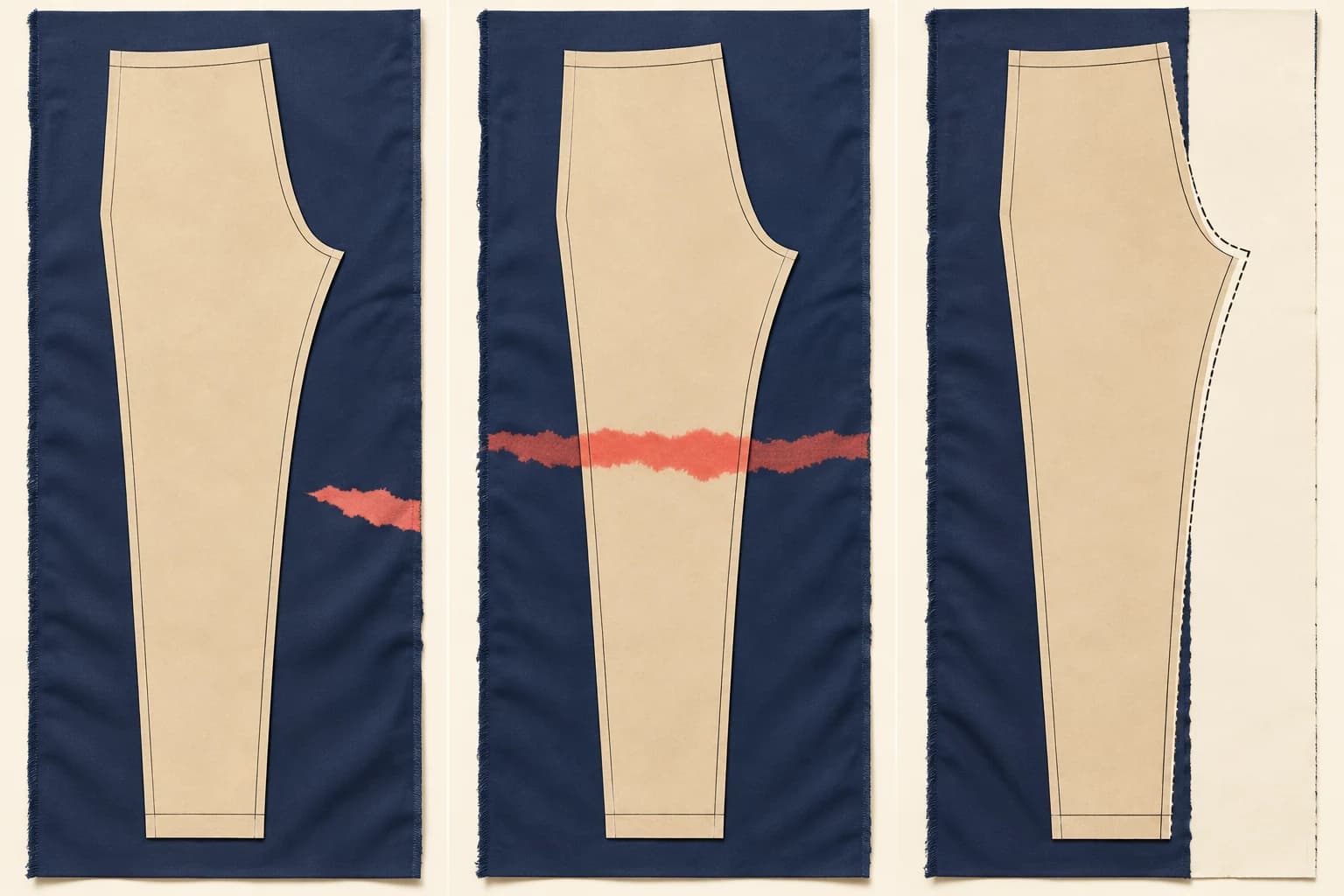
A defect outside the proposed cut outline and a streak across the knee can have different consequences for this pant. Their commercial grading treatment still follows the agreed system. Their cutting implications need a separate explanation tied to panel placement.
This distinction prevents two opposite mistakes. You might reject usable cloth without understanding the agreed requirements, or release unsuitable cloth because a total appears low. Ask both whether the inspection result meets the contract and whether the identified cloth supports the intended cutting plan.
A shipment average also cannot tell you which physical roll should feed a particular cutting job. If individual-roll requirements apply, retain those decisions even when a shipment summary is provided. If the parties use a different acceptance arrangement, state it explicitly rather than assuming every roll is interchangeable.
06 · Decision record
Choose a disposition that names the affected work
For each unresolved roll, distinguish the possible actions. Release may apply to a defined roll and cutting scope after the required evidence is accepted. Hold means a named issue still prevents that release. Replacement addresses material that cannot meet the agreed order need.
A commercial resolution might involve another agreed allocation or remedy. It does not change a streak into clean cloth or authorize an unapproved garment redesign. Record the proposed consequence for usable quantity, material consumption, schedule and responsibility, then obtain the necessary buyer decision.
Avoid vague instructions such as “use the good parts.” Ask which parts, under which placement restrictions and for which order quantity. The pattern team should not have to infer a buyer concession from a marker on the selvedge or an informal message.
07 · Decision record
Build a useful roll disposition record
Your record should make the next action reproducible. Include the order/material reference, lot and roll identifiers, inspected scope and controlled grading basis. Attach the defect map, relevant usable-width information and the long-panel reference that explains the concern.
Then state the affected work: for example, the proposed front-leg position intersects a visible streak. Ask for a feasible alternative placement or replacement proposal. Name the person who provides technical feasibility and the buyer who accepts any resulting change in order scope.
Keep an issue open when evidence is missing. A missing defect location is not a clean result, and an unreadable width entry is not an acceptable width. Request the specific missing item instead of adding a general “approved subject to quality” note that nobody can apply.
When a decision is made, identify exactly what it covers. A release for a particular roll and approved marker does not automatically cover another lot, a changed pattern or additional sizes. Retain the relevant map and instruction with the cutting information so the physical work follows the decision.
08 · Decision record
Keep visual grading separate from other material evidence
Visible-defect inspection is one material question. RSJ’s fabric-inspection service describes customer-directed fabric checks and separate testing coordination. That distinction is useful: a visual finding does not establish how the selected material behaves in a different assessment.
Use the fabric shrinkage test guide for dimensional-change evidence. Use the fabric pilling test guide when surface change matters. Neither result replaces a map showing where a roll defect affects this long garment panel.
Finished-garment inspection comes later. The garment quality control checklist addresses the goods and shipment decision after assembly. Do not transfer a roll-grade conclusion into a finished-lot or AQL acceptance statement.
09 · Decision record
Questions to settle before cutting
Can a low roll score guarantee enough clear long-leg panels?
No. Ask the cutting team to relate actual defects and usable area to the approved panel and marker requirements. The score and the cutting assessment answer different questions. Both may be necessary under the agreed purchase conditions.
Can we change a panel to avoid the marked fault?
Only after the relevant technical and buyer review. A changed seam, orientation or leg shape can alter the product brief. Identify that proposed change before anyone treats it as an ordinary cutting adjustment. Do not let a material concession silently redesign the garment.
What should we send for a roll-specific discussion?
Send the material and roll identities, controlled inspection basis, defect locations, usable-width information and affected long-panel reference. Include the order quantity and the proposed action. Ask a named person to resolve the exact issue that prevents cutting.
10 · Decision record
Discuss the material decision with the garment brief
The proposed ankle-zip team track pants provide the construction context for this example. Their artwork establishes no inspection result. Material, pattern and component choices remain subject to feasibility review and sampling.
Forthright supports buyer-led apparel development. MOQ is 300 pieces per style and color. Samples usually take 7–10 days after a clear brief; bulk planning is usually 30–45 days after approval, order confirmation and material readiness. Additional development and order details can affect timing.
Contact Forthright with the garment reference and the material question you need to resolve. We can begin with the identified brief and discuss what evidence and technical review are needed before the next step.