





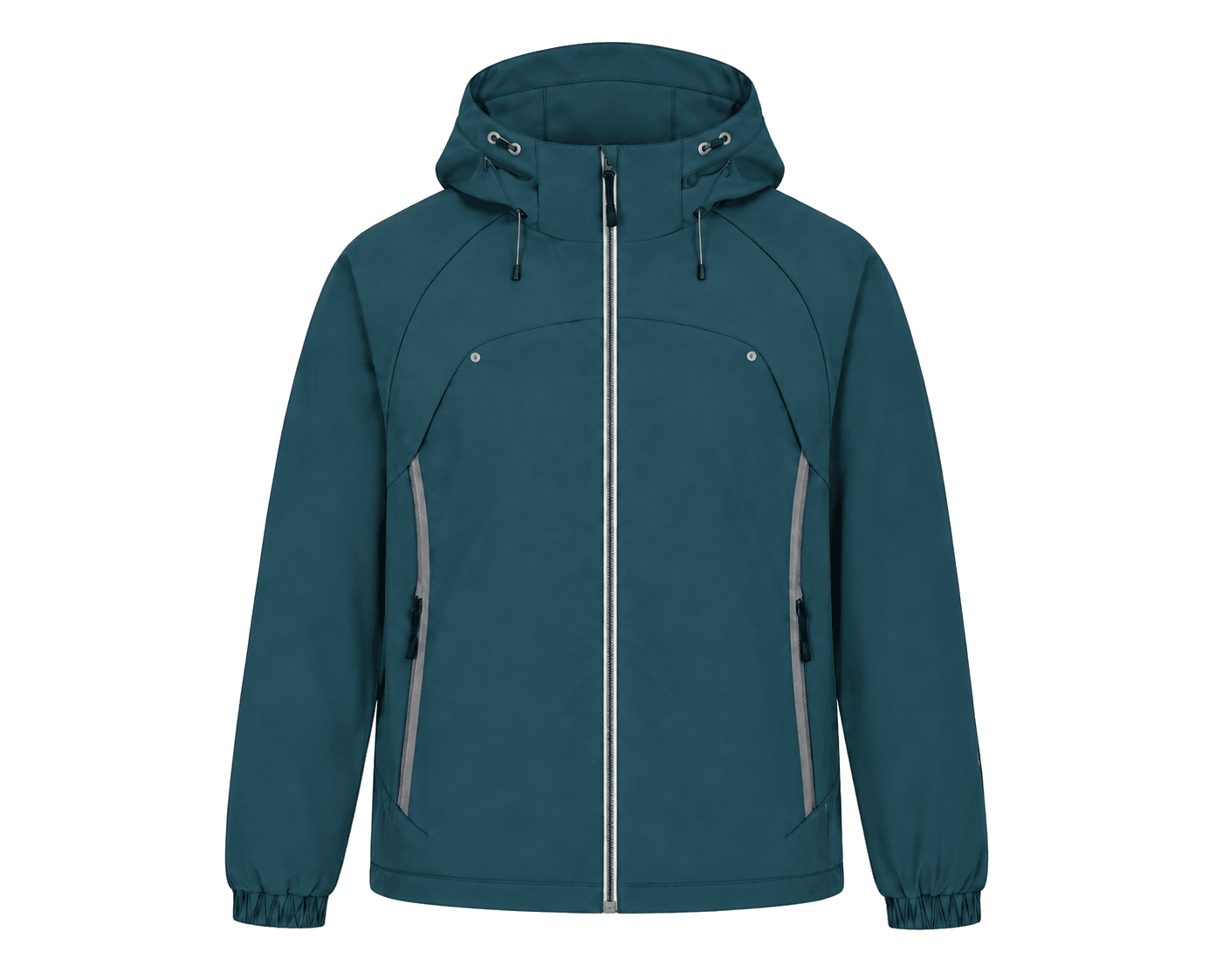
Comparing waterproof vs water-resistant jackets starts with the intended use, water-protection claim and supporting test evidence. Before manufacturers quote the order, define the required fabric, garment construction and sample approval conditions. A video of droplets beading on a sleeve cannot settle those purchasing decisions. Apparel sourcing teams need a traceable brief covering the selected fabric, seams, closures and intended use.
This guide helps apparel buyers turn broad terms into a sample and quotation brief. It does not assign a waterproof rating to Forthright's catalog products; performance must be established for the specified material and finished construction.
01 · Decision record
1. Define the use before choosing the claim
Start with the wearing situation: a short walk in occasional drizzle, an outdoor event, or prolonged exposure to rain. Record the activity, expected conditions and any layering requirements. These scenarios may call for different materials and garment construction.
REI's rainwear guidance distinguishes water-resistant lightweight layers from waterproof rainwear. The terminology is useful for discussing intended use, but a product name such as “windbreaker” is not test evidence. Ask what the proposed garment has actually been assessed to do.
A buyer brief should state the desired claim, the evidence needed and who will approve it. If a requirement is still undecided, keep it as an open specification rather than allowing the supplier's product description to become your acceptance criteria.
02 · Decision record
2. Separate surface repellency from resistance to penetration
Water repellency concerns how the surface responds to water. A durable water-repellent finish can make droplets bead and roll away. Waterproof constructions may also use a coating or membrane; the surface finish and the underlying barrier perform different jobs.
REI explains that the outer fabric of a waterproof garment can become saturated when its water-repellent finish deteriorates even while the barrier beneath it continues to resist penetration. That is one reason a beading demonstration alone cannot establish the performance of a complete jacket.
Keep three questions separate in the RFQ: What happens at the outer surface? What evidence addresses water passing through the material? What evidence addresses the finished garment? The answers should identify the exact construction rather than relying on a fiber name such as nylon or polyester.
03 · Decision record
3. Ask what each test actually measures
AATCC lists TM22 for water repellency using a spray method and TM127 for water resistance using hydrostatic pressure. They address different properties. A supplier should not present the result of one as though it answered the other question.
Ask for the method and version, the specimen description, conditioning or pretreatment, result and agreed acceptance requirement. For a durability requirement, specify the care or aging conditions to be applied before reassessment. Have the laboratory confirm that the requested method suits the material and the intended evaluation.
A number without a method is difficult to compare. Two reports with different procedures or specimen preparation should not automatically be ranked by their headline values. Keep breathability requirements on a separate line as well; a water-resistance result does not establish moisture-vapor performance.
04 · Decision record
4. Review seams, openings and the finished sample
A material report describes the tested material. It does not, by itself, demonstrate the protection provided by a jacket assembled from that material. SGS describes water assessment at both material and finished-garment levels, including a whole-garment rainfall evaluation.
Use the sample review to identify construction questions:
- Which seams and joins require sealing for the intended claim?
- How are the front closure, pocket openings and other entry points designed?
- What happens around the hood opening, cuffs and hem during the intended movement?
- Do decoration, badges or other additions introduce points that need review?
- Does the final sample use the same material, trims and construction as the proposed production version?
Ask the supplier to identify unresolved details, then agree which need a revised sample or relevant testing. A visual check can reveal a construction question; it cannot certify that the garment passes a rainfall test.
05 · Decision record
5. Make supplier quotations comparable
For a lightweight outer layer, begin with the lightweight jacket manufacturing and material guide. Separate shell construction, finish, lining and required checks in the brief. The OEM contrast-piped hooded jacket reference provides a starting point for discussing seam layout and hood details, not a verified waterproof specification.
Ask each supplier to state the same scope: selected fabric, finish, seam construction, closures, requested testing, labels and packing. If one quotation leaves testing or seam sealing unresolved, label those items as pending instead of treating them as included at no cost.
Use the apparel RFQ comparison guide to compare those assumptions before negotiating the final number. An alternative material or construction should be priced as a separate option with its evidence and limitations clearly identified.
06 · Decision record
6. Record OEM jacket performance specifications
Use the following fields in your development notes. The buyer and supplier should complete the open decisions together; the list is not a universal testing standard.
- Intended use: activity, weather exposure and layering expectations.
- Product claim: the exact wording being considered and the evidence required.
- Material identity: reference, composition, construction, finish and revision.
- Surface repellency: method, pretreatment and agreed acceptance requirement, if applicable.
- Resistance to penetration: method, specimen preparation and agreed requirement, if applicable.
- Garment construction: seams, closures, openings and decoration to review.
- Finished-garment assessment: requested scope, procedure and acceptance decision.
- Care durability: instructions, assessment conditions and any repeat checks.
- Report traceability: laboratory, report reference, date and tested sample identity.
- Approval control: retained sample, comments, unresolved items and authorization for changes.
Request the full relevant report rather than relying on a cropped result image. Check that its sample description matches the material or garment being ordered. If the supplier changes the finish, fabric or construction after approval, decide which evidence and checks must be renewed before accepting the change.
07 · Decision record
7. Resolve a mismatch before production
Consider an illustrative sourcing exercise: the buyer needs a jacket for sustained rain, while the quotation only specifies a water-repellent shell and provides a spray-test result. The gap is not solved by changing the product title to “waterproof.”
Ask the supplier to explain whether the proposed construction can meet the intended requirement, identify the additional assessment needed, and revise the offer accordingly. If the revised scope does not suit the project, change the product brief openly or choose a different construction. This is a teaching example, not a Forthright test result or customer case.
Record the final decision with the approved specification. That gives merchandising, production and inspection a common reference instead of three different interpretations of the word “waterproof.”
08 · Decision record
Questions buyers often ask
Are windbreakers waterproof?
The name does not establish that. Confirm the specific fabric, construction and supporting evidence. A wind-resistant lightweight layer may suit brief light rain without meeting the requirements of a rainwear program.
Does a spray-test result prove a jacket is waterproof?
No. Surface repellency and resistance to water penetration are different questions, and the complete garment also has seams and openings. Match the assessment to the intended claim.
What should I send for a jacket quotation?
Send the intended use, drawing or reference style, quantity by color and size, material preferences, construction details and required performance evidence. Request an OEM jacket specification review with open requirements clearly marked so the proposed sample and quotation address the same decisions.